Director Destin Daniel Cretton Interview

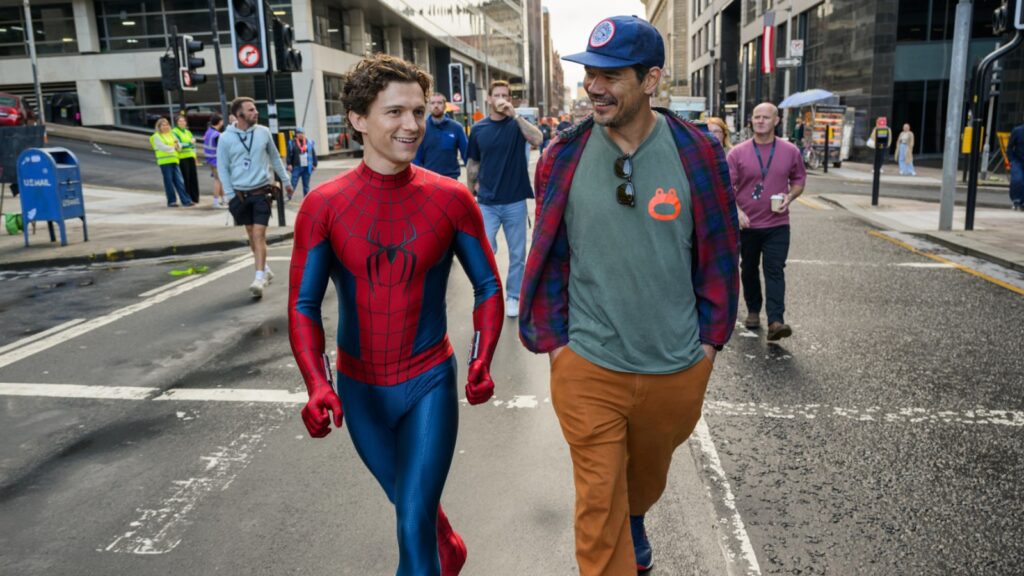
The MCU has had its ups and downs since 2019’s Avengers: Endgame, but 2021’s Shang-Chi and the Legend of the Ten Rings was an undisputed high point, with visceral martial-arts action and comedy moments that actually managed to be funny. It seemed inevitable that the film’s director, Destin Daniel Cretton, would return with another Marvel project, but it’s taken a while; his Shang-Chi sequel is still in development, and he spent a year or so attached to the never-made Avengers: Kang Dynasty, which ended up being replaced by the Russo brothers’ Avengers: Doomsday, due in December. But this year, Cretton is back in the world of Marvel with two projects: January’s excellent Disney+ show Wonder Man, and Spider-Man: Brand New Day, the fourth Tom Holland Spidey film, out July 31.
Brand New Day picks up from 2021’s Spider-Man: No Way Home, which ended with all memory of Peter Parker erased via magic spell. He’s an isolated adult now, with no life other than his crime-fighting as Spider-Man, while MJ (Zendaya) and Ned (Jacob Batalon) go on with their lives without him. The film brings in the Punisher (Jon Bernthal) and Bruce Banner (Mark Ruffalo), and also stars Sadie Sink as a still-undisclosed character, though many fans think she’s playing Jean Grey of X-Men fame. Cretton sat down with Rolling Stone in a Manhattan hotel to discuss the secrecy around Sink’s role, what Holland brought back from The Odyssey, the fate of Shang-Chi 2, and more.
Based on seeing the first 35 minutes or so of the new movie, I can say it looks like you’ve now nailed three superhero projects in a row. Do you have an overriding philosophy about how to approach this particular genre?
Ooh. I don’t do any movie just to do the movie. I didn’t do Shang-Chi just because I wanted to do a superhero movie. I didn’t do Spider-Man just because I wanted to do a Spider-Man movie. I do have to find the piece of it that gives me the same feeling that I had when I made an indie like Short Term 12, something that feels very personal, very intimate. Until I find that, I don’t feel like I could do a good job. I don’t feel like I would be the right person to tell that story.
And I told [No Way Home director] Jon Watts this, that the gift he gave me was the ending of the last movie — which was putting Peter Parker at a place where all he has at that point in life is work. He’s been stripped of his community. He’s gone through some pretty intense tragedy in his life. And he’s at a place where he feels like it’s his duty to be alone and to work. And I’ve been in that place in life. I’ve been at that place multiple times in my life, and I know what that feels like to trick yourself into thinking that is your destiny to be alone and to work.
So from the get-go, I felt very connected to the place that Peter Parker is. And what I really love about storytelling is taking a character from a place that I’ve been and watching him figure out how to get out of that place. And that’s the journey that Peter Parker is on in this film.
Judging by box office and by creative success, the two most endlessly renewable characters in this genre are Batman and Spider-Man. What’s your theory as to why?
There’s a lot of similarities, like the tragedy that they’ve been through, the loss. Both characters have a deep soul. They have a very clear moral compass. They are trying to do whatever their version of good is in the world, despite the tragedy that they’ve been through.
For me, spending time with Peter Parker is truly a life-changing experience. Spending time with a character who is constantly trying to be good, who somehow, despite the really traumatic things that have happened in his life, still has this lightness, this joy, this childlike innocence to what he believes is the right thing to do. He chases what he believes is right with this fervor that I find really exhilarating. Even when he’s wrong — ’cause he’s wrong a lot — the way that he chases what he believes is right is something that I find very contagious. I like exploring characters like that, because I feel like it rubs off on me in a way.
From the first time we see Peter at the top of a building, the way you shot it, I felt something that I’ve maybe never felt in a Spider-Man movie, which was a sense of real height and vertigo and danger. I wondered how much of that was on your mind.
That was a huge thing that was on our mind from the very beginning, was how do we create a sense of vertigo? How do we allow the audience to really feel like they’re right there with Spidey when his toes are hanging off the edge of a skyscraper? What would it feel like to be with him as he’s diving and reaching terminal velocity? How do you really feel the speed of what that swing would be like after the dive? Because of advancements like how small cameras can get these days, we were able to now look at YouTube footage of wingsuiters and parkour — parkourers? I don’t know what you call them [laughs] — and analyze what angles make your heart drop, that make you feel like you’re right there with them.
Of course, we’re analyzing the other [Spider-Man] movies, and this movie doesn’t exist without the building blocks of the other films. I do think for this film, we wanted the swinging and that experience to feel fresh. So we’re primarily looking at GoPro footage on YouTube.
Tom Holland is now the empowered star of the franchise who is a producer of this film, and then this movie was delayed for The Odyssey, so he came in with that experience under his belt — and he’s said it changed a lot of his thoughts about filmmaking. How did those two things affect the movie?
It’s true that the real character of a person comes out once they have power, and thank goodness the true character of Tom Holland is a really good person. He’s extremely open and collaborative. He comes in with a lot of great ideas. But he understands the process is a collaborative art form and that we have to find our way together to something that makes sense for the movie as a whole. And he was an energizing joy to have interjected into the creative process when he came in.
What did he bring from The Odyssey? I think he brought a lot of the things that I love about filmmaking, which is, like, an insane work ethic. It’s the willingness to get down and dirty and to take some risks and try to create something that feels a little … When you really want something to feel fresh for an audience we do have to take some swings that may be a little more out of the box. And I think that experience made him even more willing to take some of those swings.
You said that you asked him to do things that were close to impossible physically and that he pulled it off. What are some examples of that?
A lot. Yeah. A lot of things. It’s rare to find an actor who is such a great performer, both in a scene with comedy and drama, but also with body performance. And it’s probably his muscle memory from being a dancer, I’m guessing.
But a lot of those covers that we were shooting required acting at 420 frames per second.
You’re referring to the moments when you re-create some famous comic-book covers.
Yeah. His ability to control his body to get into the pose of a cover — we’d look at the cover, and some of the covers are not necessarily something that the human body can get into, the way that these poses are. He was able to look at it and, in just a few takes, he would go and do it, and we’d analyze what his body was doing, and he’d say, “Oh, I think I can … yeah, I think I can do it better,” and he’d go back in. It was pretty amazing to watch.
What is the thinking behind keeping the Sadie Sink character secret? And is there a concern that, when you have a secret, if the answer isn’t satisfying, it just makes people mad?
If people are gonna get mad, I can’t control that! I wish everything was a secret. Some people wanna know everything, and some people don’t. There are certain people like me — if I know I’m gonna watch a movie, I try not to even watch the trailers. But you’ll see when you watch the movie that there’s a very real reason not to tell people who Sadie Sink is playing. And I don’t think you’ll get mad at it. I think you’ll be like, “Oh, I’m glad I didn’t know that.”
Tramell Tillman plays a character from the comics who’s associated with mutants, so there’s a little bit of a potential spoiler there. He’s the head of Damage Control in the movie, and in the part of the movie I’ve seen, comes off as fairly benign, but is perhaps hiding things. He is the perfect actor to play someone who is perhaps hiding levels.
Is that your assessment? [Laughs.]
That is my assessment.
Oh, yeah? Cool. [Laughs.]
I could flip it and say, tell me about casting him.
Tramell, I loved him in everything that he’s done. In Mission: Impossible, obviously, and in his incredible work in TV. He’s just an amazing actor and a wonderful person. I would work with him again in a second.
And Sadie, I think her greatness speaks to itself, but what was it specifically about her?
I worked with Sadie when she was, I think, 14 years old. I worked with her on The Glass Castle, and I’ve just been watching her career ever since. It’s just so cool to be able to work with her again after all these years. But I went and saw her in John Proctor Is the Villain on Broadway, and she just rocked me. I was bawling my eyes out at the end of that show. And you’ll see her performance in this movie is unbelievable. Unbelievable.
There’s a villain montage at the beginning of the movie where you just see Spider-Man being Spider-Man. And that’s the kind of thing where it’s very quick onscreen, but not quick to shoot. There were presumably a lot of fun discussions of which villains to include. So tell me about putting that together.
Montages suck! Every shot is not just a new setup, it’s a new location. It’s sometimes a new time period. So they suck to shoot, but they’re really fun to watch. We’re telling the story of what Peter Parker did over the four years that his friends are at school. And who we were going to include was less of a concern and more what we were trying to show is him cleaning up the city, and which [book] covers kind of helped us tell that story. And what was fun, was choosing the covers that allowed us to imagine what could’ve happened a little bit before or a little bit after that frame that we’re all used to seeing.
Tom said that the title, Brand New Day, really comes into play in, quote, “the final frame of the movie.” Was he talking out of turn?
The title, to me, does reflect where he ends up. The journey of this movie is about searching for that feeling of a brand-new day. I don’t think he really has that feeling in the beginning of this movie. And I do feel like that’s the theme of this film.
This is still the biggest movie you’ve done so far. Given that you started in low-budget movies, is there still a moment, when you’re sitting on a city street and there’s tanks and everything — do you have to pinch yourself and realize, “Yeah, I’m in charge of this. It’s come this far”?
Oh, yeah. All the time. I’ve always felt like that on every set. Even on Short Term 12, which was like a $700,000 project. Any time I step on set and hundreds of people who are all working to tell the story that at one point you were just in a little room trying to write these words onto a page, and then you see all of these, on this movie it’s like thousands of people who are all passionately working to make this story the best that it can be, it’s humbling to realize that all of these people are trying their best to make me look good and make Tom look good, make Zendaya look good. And that to me is the magic of this medium. There’s not many other experiences where you can work with that amount of creative brains on a single project.
Why are some superhero movies working and others failing?
Whether it’s the superhero genre or Project Hail Mary, there are a lot of reasons why something of that genre shouldn’t work or couldn’t work. But the movies that I connect with, you can see at its core there is something thematically that is clearly personal to the director. I think that there’s something emotionally in it. You can see there’s a person behind [it] that feels those emotions, that is fighting for those types of scenes to be in the movie. I felt that with Project Hail Mary. I feel that with Ryan Coogler’s work that he does in this genre. But that’s, to me, the common thing for any movie that I personally connect with, whether it’s a big movie or an indie.
Can you briefly explain your initial thoughts on your approach to the Naruto movie you’re gonna do? Given the popularity of the anime series, that’s arguably as big a franchise as Spider-Man.
Honestly, no different than anything else that I’ve done. The cool thing is I feel very connected to that character, and I have always felt that way. When I met Kishimoto-san, the creator, it just amplified that feeling of connection. I think his journey in the story that we are going to tell is something that I find very personal not only culturally, but emotionally. His trajectory, his feelings of being an outsider, the feeling of having an ugliness or a monster or some part of you that you’re ashamed of, and then coming to realize that’s the part that makes you unique, that gives you your power, that is a story that feels very close to me.
I know personally I really would like to see Shang-Chi 2. Is that still in development?
Yeah. I also would love to see Shang-Chi 2! I was talking to Dave Callaham, our writer, about it just a few weeks ago, so fingers crossed.
‘The Five-Star Weekend’ Is Peacock’s Latest Airport-Novel Hit
A good book does not always equal a great watch. But in the modern streaming era, TV...
Chappell Roan, Ariana Grande Will Guest Judge
RuPaul’s Drag Race All Stars is celebrating its 10th season with a brand-new format...
Gwyneth Paltrow Says Her Ski Trip Lawsuit Was ‘Ridiculous’
“That’s why I felt like I had to fight it,” Platrow said Gwyneth Paltrow...
Jeremy Renner Explains Why He Turned Down ‘Hawkeye’ Season 2
“Did you think I’m only half the Jeremy because I got ran over?” said the...